
How to Choose the Right Icebreaker for Your Meeting’s Goal. You’ve seen it happen: A well-intentioned facilitator kicks off an important strategy meeting with an elaborate getting-to-know-you game that eats up 20 minutes. The team is restless. Energy drains instead of building. The icebreaker that was supposed to energize the group has actually derailed the meeting before it began.
Or perhaps the opposite: A team that barely knows each other dives into a high-stakes brainstorming session with zero warm-up, and the meeting is stiff, awkward, and unproductive. People hold back ideas. Silence dominates. The meeting ends with everyone frustrated.
Both scenarios share the same root problem: a mismatch between the icebreaker and the meeting’s purpose.
Not all icebreakers are created equal, and not every icebreaker works for every situation. A creative, playful activity perfect for a brainstorming session might be completely inappropriate for a quarterly business review. An introspective sharing exercise ideal for a new team might bore a group that’s worked together for years.
The key to effective icebreakers isn’t finding the “best” one—it’s finding the right one for your specific context. In this guide, you’ll learn a strategic framework for matching icebreakers to your meeting’s goals, assessing your audience, and facilitating with purpose rather than hoping for the best.

Stop Picking Icebreakers at Random
Most people choose icebreakers one of three ways:
- The Last-Minute Scramble: They Google “meeting icebreakers” five minutes before the meeting starts and pick whatever looks quick.
- The Comfort Zone Default: They use the same icebreaker they always use, regardless of whether it fits the situation.
- The Copycat Method: They remember an icebreaker someone else facilitated and try to replicate it without understanding why it worked (or didn’t) in that context.
None of these approaches are strategic. They treat icebreakers as generic add-ons rather than purposeful tools aligned with specific outcomes.
The result? Icebreakers that feel forced, waste time, create awkwardness, or worse—actively work against your meeting’s objectives.
There’s a better way: a systematic approach to selecting icebreakers that considers three critical factors:
- Your meeting’s primary goal
- Your audience’s characteristics
- Your time and resource constraints
Let’s break down each factor and build a decision-making framework you can use for any meeting.
Step 1: Define Your Meeting’s Primary Goal
Every meeting should have a clear primary objective. If you can’t articulate what you’re trying to accomplish, no icebreaker will help—because you don’t know what you’re preparing people for.
Common meeting goals include:
Goal: Information Sharing / Status Updates
Purpose: Communicating updates, sharing data, or reporting on progress.
What participants need: Focus, attentiveness, and willingness to ask clarifying questions.
Icebreaker characteristics that work:
- Brief (under 5 minutes)
- Energizing but not overly playful
- Focus-building rather than vulnerability-inducing
- Individual rather than collaborative
Examples that work well:
- One-word check-ins (“Describe how you’re feeling in one word”)
- Quick wins sharing (“Share one accomplishment from this week”)
- Random name selector to determine presentation order (adds fairness and slight suspense)
Why this works: Information-heavy meetings require attention and mental clarity. Your icebreaker should wake people up and get them focused, not drain their energy with elaborate activities. The goal is to shift people from scattered attention (email, Slack, lingering thoughts from their last meeting) to present-moment focus.
What to avoid: Long storytelling exercises, deep personal sharing, or complex games that leave people mentally fatigued before the real content begins.
Goal: Decision Making
Purpose: Reaching consensus, making choices, or solving problems that require agreement.
What participants need: Clear thinking, willingness to speak up, and ability to disagree constructively.
Icebreaker characteristics that work:
- Encourage different perspectives
- Build comfort with disagreement
- Quick and efficient
- Create psychological safety for dissent
Examples that work well:
- “This or That” preferences with light debate (e.g., “Coffee or tea? Morning person or night owl?”)
- Friendly debate topics with playful disagreements to normalize differing views
- Fist-of-five confidence checks on non-controversial topics
Why this works: Decision-making meetings often suffer from groupthink or from conflict avoidance. An icebreaker that normalizes disagreement—in a low-stakes, playful context—primes people to voice different perspectives when it matters. If you can disagree about whether pizza is a sandwich, you can disagree about the product roadmap.
What to avoid: Activities that emphasize harmony and agreement at all costs. You want constructive tension, not forced consensus.
Goal: Creative Brainstorming / Ideation
Purpose: Generating ideas, exploring possibilities, or thinking divergently.
What participants need: Mental flexibility, playfulness, freedom from judgment, and associative thinking.
Icebreaker characteristics that work:
- Playful and creative
- No right answers
- Encourage wild ideas
- Break conventional thinking patterns
- Medium length (5-10 minutes is fine)
Examples that work well:
- “Alternative uses” challenges (How many uses can you think of for a paperclip?)
- “Worst possible idea” warm-ups (intentionally generating bad solutions to practice non-judgment)
- Quick collaborative drawing or storytelling
- Creative scavenger hunt challenges
Why this works: Creativity requires getting out of logical, linear thinking modes. Playful, absurd, or unexpected icebreakers activate associative thinking and lower people’s internal critics. When you’ve just spent 5 minutes thinking of ridiculous uses for a rubber band, you’re much more likely to propose unconventional ideas in the brainstorm that follows.
What to avoid: Highly structured, serious, or competitive activities. You want to loosen people up, not make them self-conscious about performance.
Goal: Team Building / Relationship Development
Purpose: Strengthening relationships, building trust, or helping team members know each other better.
What participants need: Opportunities for vulnerability, personal sharing, and discovering commonalities.
Icebreaker characteristics that work:
- Personal but not invasive
- Encourage storytelling
- Create moments of shared vulnerability
- Longer duration is acceptable (10-15 minutes)
- Often work in pairs or small groups first
Examples that work well:
- Two truths and a lie (reveals personality, creates intrigue)
- “Journey line” activities (mapping personal or professional paths)
- “Personal user manual” sharing (how I like to work, communicate, receive feedback)
- Rose/Thorn/Bud reflections (something good, something challenging, something I’m looking forward to)
Why this works: Trust is built through graduated vulnerability. These icebreakers give people permission to share something real about themselves in a structured way, with reciprocity built in. When someone shares their truth and others respond with acceptance, oxytocin releases and bonds form (see our article on the science behind icebreakers for more on this).
What to avoid: Surface-level activities that don’t invite any real sharing. If you want to build relationships, you need to go deeper than “What’s your favorite color?”
Goal: Problem Solving / Troubleshooting
Purpose: Diagnosing issues, analyzing challenges, or working through obstacles.
What participants need: Critical thinking, willingness to challenge assumptions, and comfort with complexity.
Icebreaker characteristics that work:
- Analytical or puzzle-based
- Encourage questioning and skepticism
- Reward looking at problems from multiple angles
- Brief to moderate length
Examples that work well:
- Logic puzzles or riddles
- “Five Whys” practice on a neutral topic
- “What’s wrong with this picture?” exercises
- Trivia questions that reward critical thinking
Why this works: Problem-solving requires a particular mental mode: curious, questioning, and willing to dig beneath surface explanations. Icebreakers that exercise these muscles prepare the brain for the analytical work ahead.
What to avoid: Purely social or emotional activities. You want cognitive engagement here.
Goal: Conflict Resolution / Difficult Conversations
Purpose: Addressing tension, working through disagreements, or having hard conversations.
What participants need: Emotional regulation, empathy, and willingness to see other perspectives.
Icebreaker characteristics that work:
- Build empathy and perspective-taking
- Acknowledge emotions without amplifying them
- Create safety and neutrality
- Very brief (you can’t afford much time here)
Examples that work well:
- Perspective-taking exercises (“If you were in X’s shoes, what would concern you?”)
- Shared values identification (“What do we all agree is important?”)
- Emotional check-ins with a focus on acknowledgment, not problem-solving
Why this works: When tensions are high, people need to feel heard and to see the humanity in those they’re in conflict with. A brief activity that builds empathy or identifies common ground can shift the tone from adversarial to collaborative.
What to avoid: Anything too playful or lighthearted (reads as dismissive of the conflict). Also avoid activities that amplify disagreement or competition.
Goal: Training / Learning
Purpose: Teaching new skills, concepts, or information.
What participants need: Engagement, curiosity, and readiness to absorb new information.
Icebreaker characteristics that work:
- Activates prior knowledge on the topic
- Creates curiosity gaps
- Assesses baseline understanding
- Primes the brain for learning
Examples that work well:
- Quick quiz or poll on the training topic (creates awareness of what they don’t know yet)
- “What do you hope to learn?” sharing
- “One thing you already know about [topic]” sharing
- Myth-busting warm-ups (“True or false: [common misconception]?”)
Why this works: Adult learning theory tells us that people learn best when they can connect new information to existing knowledge and when they’re curious about what they’re about to learn. Icebreakers that activate prior knowledge or create curiosity gaps set the stage for effective learning.
What to avoid: Icebreakers completely unrelated to the training content. Use the warm-up to bridge into your material.
Step 2: Assess Your Audience
Even with a clear meeting goal, you need to consider who’s in the room. The same icebreaker can land completely differently depending on your audience.
Consider These Audience Characteristics:
Familiarity Level
New team or strangers: Need icebreakers that help people learn names, discover commonalities, and build initial trust. Focus on getting-to-know-you activities.
Established team: Can skip introductions and go deeper. They need icebreakers that maintain engagement, not create it from scratch.
Mixed familiarity (some know each other, some don’t): Trickiest scenario. Choose activities that work for both—like interesting questions that reveal new information even about people you think you know well.
Personality and Energy
Introverts: Prefer activities with think-time, written responses, or pair work before large group sharing. Avoid put-on-the-spot performances.
Extroverts: Energized by interaction, quick pace, and spontaneity. Enjoy activities that involve movement and group participation.
Mixed groups (most realistic scenario): Offer choice where possible (“You can share out loud or in the chat”) and include both reflection time and interaction time.
Cultural and Generational Differences
Different cultural backgrounds: Be mindful of activities that assume shared cultural references or that might create discomfort in certain cultures (e.g., excessive personal sharing, physical touch, or competitive comparison).
Age diversity: Avoid activities heavily dependent on recent pop culture or technology that might exclude certain age groups. Similarly, avoid dated references that younger team members won’t connect with.
Seniority and Power Dynamics
Cross-level meetings (executives and individual contributors together): Choose icebreakers that level the playing field. Leaders should go first to model vulnerability.
Peer groups: More freedom to be playful and informal.
Customer or client present: Keep it professional. Skip anything that might seem like an inside joke or waste of their time.
Virtual vs. In-Person vs. Hybrid
Virtual meetings: Leverage technology (polls, chat, digital whiteboards) but keep it simple. Tech glitches kill momentum. Activities like two truths and a lie translate well to video calls.
In-person meetings: Can include movement, physical objects, and more complex logistics.
Hybrid meetings: The hardest to facilitate. Choose activities that don’t disadvantage remote participants. Digital-first tools work best—everyone uses the same platform regardless of location.
Step 3: Consider Your Time and Resource Constraints
Finally, factor in practical limitations:
Time Available
Under 3 minutes: One-word check-ins, quick polls, single questions
3-5 minutes: Short games, brief sharing rounds, simple trivia questions
5-10 minutes: Getting-to-know-you activities, collaborative challenges
10+ minutes: Deep sharing, elaborate games, team-building exercises
Tip: Always budget more time than you think you’ll need. Icebreakers often run long, especially with larger groups.
Group Size
Small groups (under 8): Everyone can share; go-arounds work well
Medium groups (8-20): Break into pairs or small groups for sharing; use structured activities
Large groups (20+): Use technology (polls, chat), breakout rooms (virtual), or pair work; avoid activities requiring everyone to share with the full group
Resources and Technology
No tech needed: Questions, storytelling, conversation-based activities
Basic tech (video call with chat/polls): Digital icebreakers, polls, chat-based responses
Advanced tech (digital whiteboard, specialized platforms): Collaborative drawing, complex games
Physical materials: Objects, cards, props (only if you’re in-person and can distribute them)
The Decision Framework: Putting It All Together
Here’s how to systematically choose the right icebreaker:
Step 1: Start with Your Meeting Goal
What are you preparing people for? Match the icebreaker’s energy and purpose to the meeting’s primary objective.
Step 2: Filter by Audience
Who’s in the room? What do they need to feel comfortable and engaged?
Step 3: Apply Practical Constraints
How much time do you have? What’s your group size? What tools are available?
Step 4: Select 2-3 Options
Never go into a meeting with just one icebreaker. Have a backup in case the room’s energy doesn’t match your expectation.
Step 5: Prepare Thoroughly
Know exactly how you’ll explain the activity, what the timing will be, and how you’ll transition into the meeting content.
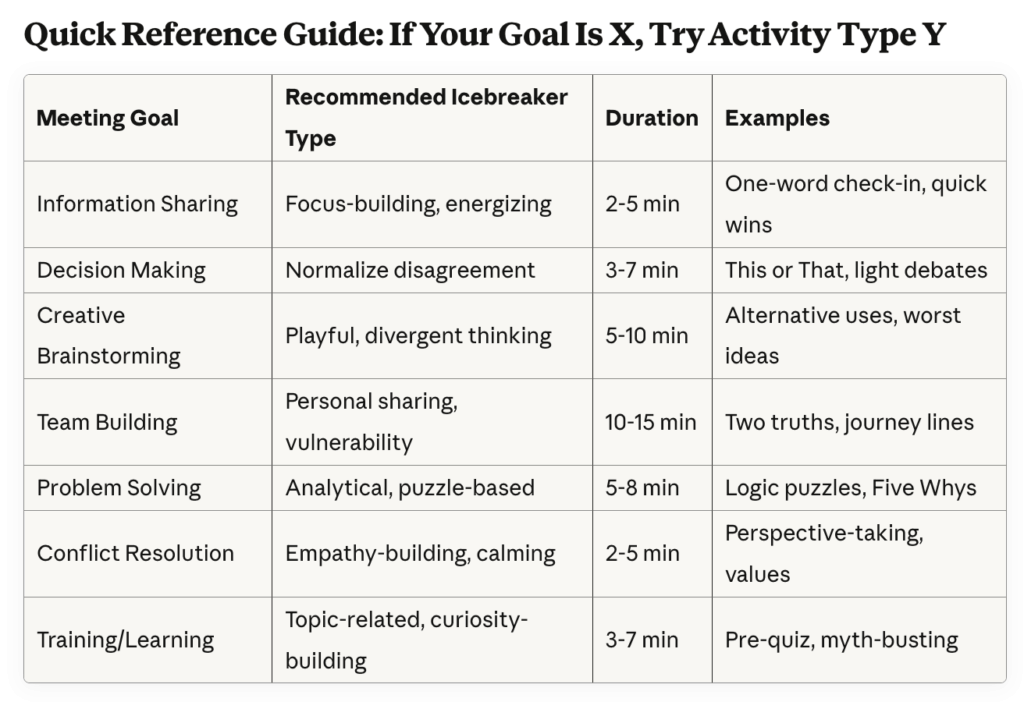
Quick Reference Guide: If Your Goal Is X, Try Activity Type Y
Common Mistakes to Avoid
Even with a good framework, facilitators make predictable mistakes:
Mistake 1: Choosing an icebreaker you love but your audience will hate Just because you enjoyed an icebreaker at a conference doesn’t mean it will work for your team’s weekly status meeting.
Mistake 2: Making it too complicated If people need more than two sentences to understand the rules, it’s probably too complex.
Mistake 3: Skipping the “why” Tell people why you’re doing the icebreaker. “We’re starting with a quick creative warm-up to get our brains ready for today’s brainstorming session.” Context increases buy-in.
Mistake 4: Going too deep too fast New teams need to build trust gradually. Don’t start with highly vulnerable sharing exercises.
Mistake 5: Ignoring the room’s energy If people are exhausted, a high-energy game will fall flat. If they’re already engaged and energized, a sleepy icebreaker will kill momentum. Be ready to adapt (more on this in our article on reading the room).
Mistake 6: Letting it run too long Set a timer and stick to it. An icebreaker that drags becomes the thing people resent, not the thing that energizes them.
Mistake 7: Not participating yourself Leaders and facilitators must participate enthusiastically. If you’re too cool for the icebreaker, your team will be too.
Matching Framework Examples in Action
Let’s walk through some real scenarios:
Scenario 1: Quarterly Planning Meeting with Established Team
Meeting Goal: Strategic planning and decision-making
Audience: Team of 10 who’ve worked together for 2 years; mixture of introverts and extroverts; meeting is in-person
Time Available: 5 minutes
Best Choice: A “This or That” discussion on strategic trade-offs. “Would you rather have 3 new features or 10x improvement on one existing feature?” This primes them for the trade-off decisions they’ll need to make and normalizes that there are valid perspectives on both sides.
Why it works: Directly relevant to the meeting’s work, doesn’t require deep vulnerability (they already know each other), quick and efficient.
Scenario 2: Kick-Off Meeting for New Cross-Functional Project Team
Meeting Goal: Team building and relationship development
Audience: 8 people who don’t know each other well; mix of remote and in-person participants (hybrid); diverse seniority levels
Time Available: 12 minutes
Best Choice: Digital two truths and a lie where everyone submits their statements via a shared form, then the group guesses together. This works for hybrid because everyone participates digitally.
Why it works: Builds relationships through personal sharing, equalizes participation across remote and in-person attendees, appropriate vulnerability level for a new team, fun and engaging.
Scenario 3: Daily Stand-Up for Agile Development Team
Meeting Goal: Information sharing and quick alignment
Audience: Team of 6 engineers; very familiar with each other; meeting is virtual and happens daily
Time Available: 90 seconds (seriously)
Best Choice: Rotating daily check-in question using a random name selector to pick who answers: “On a scale of 1-10, how confident are you that you’ll hit your goals today?” Quick, relevant, gives the team a pulse on morale and blockers without lengthy discussion.
Why it works: Ultra-fast, provides useful information, adds slight novelty to a routine meeting, rotation keeps it fair.
Scenario 4: All-Hands Company Meeting (150 People)
Meeting Goal: Information sharing with some engagement
Audience: Entire company; mix of remote and in-person; wide range of roles and seniority
Time Available: 3 minutes
Best Choice: Live poll with instant results displayed. “What’s one word that describes how you’re feeling about Q3?” or “Which company value resonates most with you this week?” Use the visualization to create shared awareness.
Why it works: Scalable to large groups, inclusive of both remote and in-person, creates shared data, very fast, no one is put on the spot individually.
Advanced Facilitation: Building Your Icebreaker Toolkit
Expert facilitators don’t just choose the right icebreaker—they build a personal toolkit of reliable options they can deploy in various situations.
Create Your Go-To List
Develop a personal list of 5-10 icebreakers you’ve practiced and can facilitate confidently. Organize them by:
- Meeting goal
- Time required
- Group size
- In-person vs. virtual
Customize for Your Context
Don’t copy icebreakers verbatim. Adapt them to your organization’s culture, inside jokes, current projects, or strategic priorities. A generic icebreaker becomes much more powerful when tailored.
Practice Your Delivery
The same icebreaker can succeed or fail based on how it’s facilitated. Practice giving clear, enthusiastic instructions. Know how you’ll handle awkward silence or technical glitches.
Debrief and Iterate
After each meeting, reflect: Did the icebreaker work? Why or why not? What would you do differently? Keep notes for next time.
Conclusion: Facilitate with Purpose
The difference between an icebreaker that energizes your meeting and one that drains it often comes down to one thing: intentionality.
When you choose icebreakers randomly or out of habit, you’re hoping for the best. When you choose them strategically—matching the activity to your meeting’s goal, your audience’s needs, and your practical constraints—you’re setting your team up for success.
The five minutes you invest in a well-chosen icebreaker can transform the entire meeting that follows. Your team will be more focused, more trusting, more creative, or more aligned—depending on what you needed them to be.
So before your next meeting, take a moment. Ask yourself: What am I really trying to accomplish? Who’s in the room? What do they need from me right now?
Then choose your icebreaker with purpose. Your team will feel the difference.
How to Choose the Right Icebreaker for Your Meeting’s Goal
Ready to try strategic icebreakers with your team? Explore our collection of meeting icebreaker tools designed for different meeting goals, team sizes, and formats. From quick check-ins to trust-building activities, find the right icebreaker for your next meeting.
Related Articles:
- The Science Behind Icebreakers: Why They Actually Work for Team Cohesion
- Reading the Room: How to Adapt Your Icebreaker on the Fly
- Quick Icebreakers for Your Daily Stand-Up or Scrum Meeting
- From Awkward to Awesome: A Guide to Leading Icebreakers with Confidence
Leave a Reply